 مواد البناء
داخل مصنع حديث لصناعات الصلب: العمليات والاختبارات والمعايير
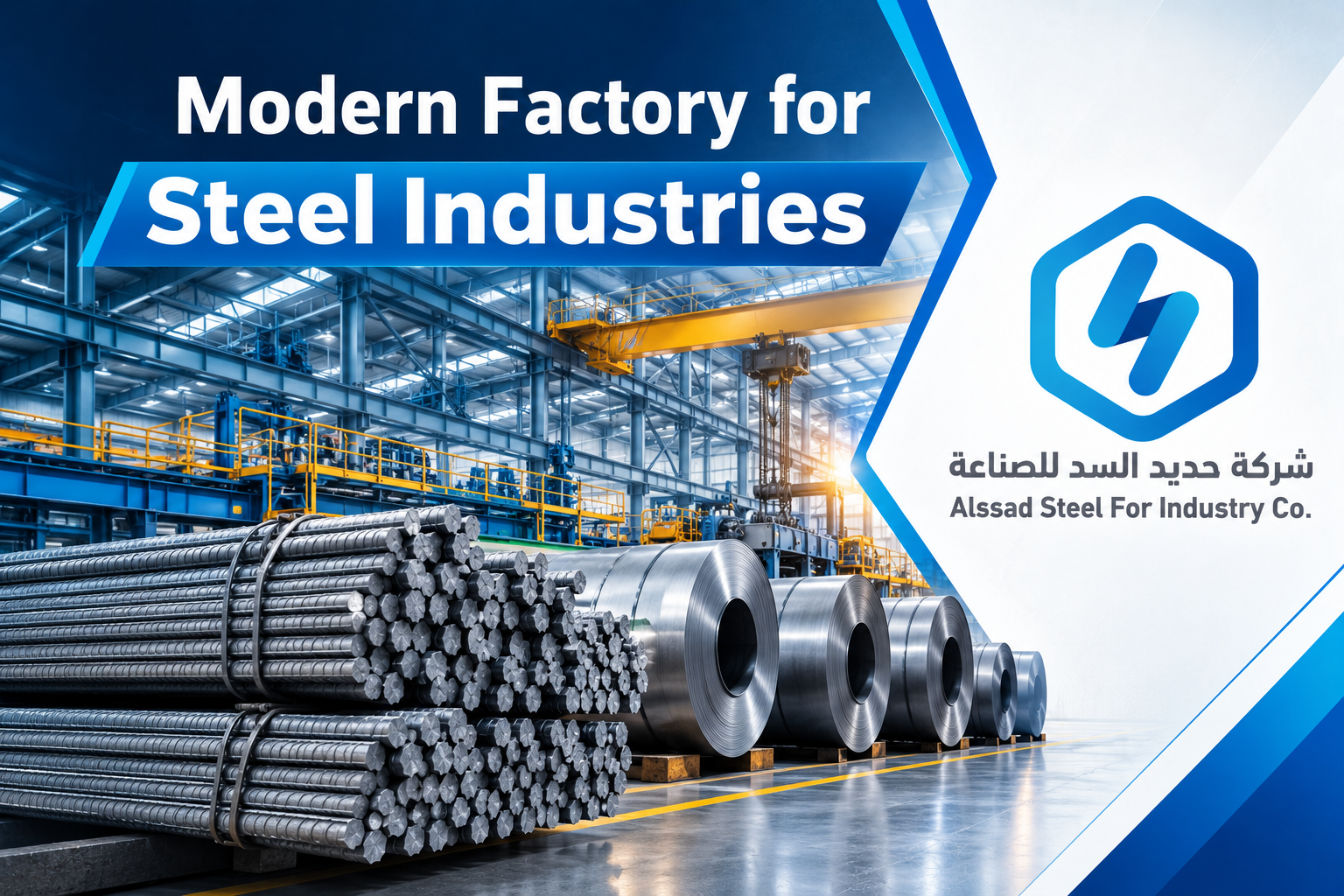
Modern Factory for Steel Industries: How Rebar Is Really Made
Alternative titles: Inside a Modern Factory for Steel Industries: Process, Testing, and Standards | Modern Factory for Steel Industries: A Buyer's Guide to Steel Plants in Saudi Arabia Meta description: What a modern factory for steel industries does differently: production stages, lab testing, traceability, and the certifications that prove your rebar is safe. Suggested slug: modern-factory-for-steel-industries Primary keyword: modern factory for steel industries — Secondary: modern steel factory, steel manufacturing process, reinforcing steel bars, SASO ASTM 615, steel factory in Saudi Arabia, rebar manufacturer Article type: Informational / evaluation guide — Word count: ~3,130
Two bundles of 16 mm rebar can look identical on the back of a truck. Same diameter, same ribs, same weight per metre. One of them will hold a column for sixty years. The other will crack during a bend test on site, and by then the pour is already scheduled.
The difference was decided long before delivery, inside the plant. This guide walks through what a modern factory for steel industries actually does between raw material and finished bar, which parts of that process protect you as a buyer, and the specific questions worth asking a supplier before you sign anything.
What is a modern factory for steel industries?
A modern factory for steel industries is a plant that converts raw or recycled metal into finished steel products under continuous instrument control, with every batch tested in an on-site laboratory and traceable back to its source material. The word modern is doing real work in that sentence: it refers to closed-loop process control, documented quality systems, and traceability, not to how recently the building was painted.
That definition matters because "steel factory" covers a wide range. Some plants melt scrap and cast billets. Some buy billets and roll them into bars. Some do both. Some run laboratories that could pass a third-party audit tomorrow; others send samples out and wait a week for results. All of them can print a spec sheet.
The production stages inside a modern steel plant
Rebar and round bar go through a sequence that has stayed structurally similar for decades. What changed is how tightly each stage is measured.
1. Raw material intake and inspection
Everything downstream inherits the chemistry of what comes through the gate. In a scrap-based operation, incoming loads are sorted and checked for contaminants — copper, tin, lead, and other tramp elements that survive melting and quietly degrade ductility. In a rolling operation, incoming billets arrive with mill certificates that state their chemical composition and origin.
A plant with a serious intake process rejects material. That sounds obvious, and it is the single most common place where discipline slips, because rejecting a load costs money today while the consequences arrive months later. Alssad Steel's production and operations setup starts from approved-supplier sourcing for exactly this reason: you cannot test quality back into a bar that started wrong.
2. Melting and casting
In an electric arc furnace (EAF), sorted scrap is charged into a refractory-lined vessel and melted by an arc struck between graphite electrodes and the charge. Temperatures pass 1,600 °C. Lime and other fluxes are added to form a slag that pulls sulphur, phosphorus, and oxides out of the bath.
The heat is then tapped into a ladle, where the composition is fine-tuned — carbon, manganese, silicon, and micro-alloying elements adjusted to hit the target grade. Samples go straight to the spectrometer. Only after the chemistry is confirmed does the ladle move to the caster, where liquid steel is poured through a water-cooled copper mould and drawn out as a continuous strand, then cut into billets.
The EAF route matters environmentally as well as technically. According to worldsteel data, the electric arc furnace share of global crude steel production reached roughly 29% in 2024, and it continues to grow, largely because EAF steelmaking runs on recycled scrap and electricity rather than coke and iron ore.
3. Reheating and hot rolling
Billets are reheated in a furnace to around 1,100–1,200 °C — hot enough for the steel to deform plastically without cracking. From there they enter the rolling mill: a series of stands, each with grooved rolls that squeeze the cross-section down and stretch the length out.
A 130 mm square billet becomes a 16 mm bar over roughly fifteen to twenty passes. The bar accelerates as it thins, which is why modern mills run loopers and tension control between stands. If tension drifts, the section drifts with it, and the bar leaves the mill underweight or out of tolerance. This is where a modern steel factory earns its description: laser gauges measure diameter in real time, and the control system corrects roll gaps without waiting for a human to notice.
The ribs are not decoration. They are cut into the final rolls to a defined height, spacing, and angle, because bond strength between steel and concrete depends on that geometry. Worn ribs on a finishing roll produce bars that meet the tensile spec and still underperform in the slab.
4. Quenching and self-tempering
After the last stand, the hot bar passes through a quenching line — high-pressure water applied for a fraction of a second. The outer layer transforms to martensite while the core stays austenitic and hot. As the bar travels onward, heat from the core flows outward and tempers that hardened rim.
The result is a bar with a tough, high-strength surface and a ductile core: high yield strength without the brittleness that heavy alloying would bring. It is also why cutting corners on quench-line water pressure or line speed shows up as inconsistent mechanical properties across a single heat.
5. Cooling, cutting, bundling, and tagging
Bars are laid on a cooling bed, cut to commercial lengths, weighed, bundled, and tagged. The tag is the part buyers underrate. On a well-run line, the tag carries the heat number, grade, size, standard, and production date, and that number ties the physical bundle to a specific test certificate.
For a breakdown of what those grades and markings mean once the steel reaches your site, our complete guide to reinforcing steel bars in Saudi Arabia covers the identification details in full.
What separates a modern plant from an older one
Ask three engineers and you will get three answers, but the honest list is short.
- Measurement replaces judgement. An older mill runs on the experience of the roller, who adjusts by eye and by feel. Some of those operators are extraordinary. The problem is that their knowledge does not survive a shift change. A modern plant instruments the process so that dimensional control is a system property rather than a personal skill.
- The process corrects itself. Automated gauges feed a control loop. When diameter drifts toward the lower tolerance limit, the correction happens in seconds, before a hundred metres of out-of-spec bar has been produced.
- Data is retained. Furnace temperatures, chemistry results, rolling parameters, and test values are recorded against each heat and stored. That record is what makes a claim auditable rather than merely stated.
- Energy is managed, not just consumed. Steelmaking is energy-intensive by nature. Plants operating a formal energy management system track consumption per tonne and treat it as a controlled variable, which shows up in both cost and emissions.
- Maintenance is scheduled. Rolls, guides, bearings, and quench nozzles wear. A plant that replaces them on a schedule produces consistent bar. A plant that replaces them on failure produces a slow drift in quality that nobody notices until a batch fails.
The laboratory decides what leaves the gate
If you visit a steel plant and only have time to see one area, skip the mill floor and go to the lab. It tells you more.
A properly equipped quality laboratory in a modern factory for steel industries runs four core tests on production samples:
- Tensile test. A sample is pulled to failure in a universal testing machine. This yields the yield strength, the ultimate tensile strength, and the ratio between them. Under ASTM A615, Grade 60 requires a minimum yield of 60 ksi (about 420 MPa) and a minimum tensile strength of 90 ksi (about 620 MPa).
- Elongation. Measured on the same broken sample, this is the ductility number — how far the steel stretches before it parts. ASTM A615 Grade 60 requires elongation in 8 inches ranging from about 9% on smaller bar sizes down to 7% on the largest. Ductility is what lets a structure deform and warn before it fails.
- Bend and re-bend test. A sample is bent around a mandrel of specified diameter and inspected for cracking on the outside of the bend. This catches embrittlement that a tensile test alone can miss, and it mirrors what actually happens when bars are shaped on site.
- Chemical analysis. Optical emission spectrometry confirms carbon, manganese, sulphur, phosphorus, and the carbon equivalent value. Carbon equivalent governs weldability, which matters the moment anyone on site reaches for a welding set.
Alssad Steel's quality and certifications programme applies these checks against SASO ASTM 615, with inspection at each production stage rather than as a final gate. The distinction is practical: end-of-line testing tells you a batch failed, while stage-by-stage inspection tells you where it started failing, which is the only information that lets you fix it.
One caution for buyers. A mill test certificate showing results comfortably above the minimum is good news. A certificate showing results that sit suspiciously close to the minimum on every single line, batch after batch, is a pattern worth asking about.
Traceability: why heat numbers matter on site
Traceability is the ability to take a bundle of steel and work backwards to the heat it was cast from, the raw material that went into that heat, and the test results recorded for it.
It sounds like paperwork until something goes wrong. A consultant rejects a delivery. A third-party lab returns an unexpected result. A crack appears during bending. Without traceability, your options are to reject everything from that supplier or accept the risk. With traceability, you isolate the affected heat, check what else from that heat is on site, and deal with a defined quantity.
For projects under the Saudi Building Code, this chain is also what your inspection regime is built on. Alssad Steel maintains a traceability system linking raw material origin to production batch, described alongside the broader integrated management system that covers quality, safety, environment, and energy in one framework.
Certifications a modern factory for steel industries should hold
Certificates do not make steel strong. They make claims verifiable, which is a different and still valuable thing — an independent body has examined the process and found it consistent with a published standard.
- SASO ASTM 615 is the product standard for reinforcing bars in Saudi Arabia, adopting ASTM A615 requirements for deformed and plain carbon-steel bars. This is the one that governs whether the bar itself is compliant.
- ISO 9001 covers the quality management system: documented procedures, defined responsibilities, corrective action when something goes out of specification.
- ISO 45001 covers occupational health and safety management. In a plant handling molten metal at 1,600 °C, safety performance and operational discipline tend to move together.
- ISO 14001 covers environmental management — emissions, waste streams, water, and the handling of slag and dust.
- ISO 50001 covers energy management, which in an energy-intensive industry is both an environmental and a cost control.
Alssad Steel holds all five, and is a member of the National Committee for Iron Industry. When you are comparing suppliers, the useful move is not to check whether certificates exist but to ask for the current certificate with its scope and expiry, then confirm that the scope actually covers the product and the site you are buying from.
Safety, environment, and energy are part of the product
There is a tempting assumption that safety and environmental systems are compliance overhead sitting beside production. In practice they are a reasonable proxy for how the plant is run.
A facility that tracks near-misses, enforces lockout procedures, and maintains its dust extraction is a facility that documents things and follows procedures. Those same habits govern whether a quench line gets calibrated and whether a failed test triggers an investigation. It is difficult to run a disciplined laboratory inside an undisciplined plant.
The environmental side has become a live commercial issue too. Saudi Arabia's industrial strategy under Vision 2030 pushes local manufacturing toward higher efficiency and lower emissions intensity, and large contractors are increasingly asked to report the embodied carbon of the materials they specify. Scrap-based EAF production carries a substantially lower emissions footprint per tonne than the blast furnace route, which is one reason the EAF share of global output keeps climbing.
Storage and delivery are part of quality
Steel that passes every test can still arrive in poor condition.
Bars stored directly on soil, in standing water, or under intermittent wetting develop surface corrosion. A light, tightly adhering film of rust is normal and does not disqualify reinforcement — some codes note that it can even improve bond. Flaking, pitted rust that reduces the cross-section is a different matter and is a legitimate reason to reject a delivery. We covered where that line sits, and how to prevent it on site, in our article on iron rust and how to stop it.
A modern plant addresses this with covered or well-drained storage yards, bundles kept off the ground, stock rotated so old material does not sit indefinitely, and delivery scheduling that avoids stockpiling months of rebar in the open. Alssad Steel operates wide storage yards and a transport network covering the Kingdom from its base in Riyadh's 2nd Industrial City, which shortens the window between production and placement.
How to evaluate a steel factory before you place an order
Here is the list worth working through with any supplier, in the order that tends to be most revealing.
- Ask for a mill test certificate from a recent heat, not a sample document. Check that the heat number on the certificate matches tags on actual stock.
- Ask whether testing is on site. In-house laboratories mean same-shift results and faster containment when something drifts.
- Ask which standard, with the full designation. "Meets international standards" is not an answer. "SASO ASTM 615 Grade 60" is.
- Ask about tolerance performance on weight per metre. Bars consistently at the light end of tolerance are legal and still cost you steel per tonne delivered.
- Ask how a non-conforming batch is handled. A supplier who describes an actual quarantine and investigation procedure is telling you the procedure exists.
- Ask to see the storage yard. It takes ninety seconds and answers questions the brochure cannot.
- Ask about lead time and delivery coverage for your specific site. Capacity that cannot reach your project on schedule is not capacity you can use.
- Ask for the certificate scope, not just the logo. Confirm the certified scope covers the site and product line in question.
- Ask about traceability depth. Can they go from bundle to heat to raw material source?
- Ask what happens when you need a technical answer at 7 a.m. on a pour day. Responsiveness is part of the product.
If you are specifically comparing suppliers in the capital region, our guide to choosing a steel factory in Riyadh applies the same criteria to that market.
Where Alssad Steel fits
Alssad Steel For Industry Company manufactures reinforcing steel bars at its facility in Riyadh's 2nd Industrial City, producing to SASO ASTM 615 with an integrated quality, safety, environmental, and energy management system behind it.
The product range covers reinforcing steel bars for construction and infrastructure, and smooth round bar steel for applications that need a plain profile. Production runs on modern rolling lines with dimensional control, supported by an on-site laboratory equipped for tensile, elongation, bend, and chemical analysis, and by a traceability system that links each batch to its raw material origin. More background on the company and its operating standards is on the about page.
Frequently asked questions
What does "modern factory for steel industries" actually mean?
It refers to a steel plant that runs on instrumented process control, on-site laboratory testing of every production batch, documented traceability from raw material to finished bundle, and certified management systems. The term describes how the plant is controlled and verified, not the age of the building.
What is the difference between an integrated steel plant and a rolling mill?
An integrated plant melts raw material and casts its own billets before rolling them into finished products. A rolling mill buys billets from elsewhere and rolls them. Both can produce compliant steel. With a rolling mill, the chemistry of your bar was determined by a supplier you are not dealing with directly, so billet certification and incoming inspection matter more.
How do I verify that rebar meets SASO ASTM 615?
Request the mill test certificate for the specific heat number tagged on your bundles. It should list chemical composition, yield strength, tensile strength, elongation, and bend test results against the standard's requirements. For critical work, send independent samples to an accredited third-party laboratory and compare.
Does surface rust mean the reinforcing bar should be rejected?
Not automatically. A thin, tightly adhering layer of surface rust is generally acceptable and does not reduce bond with concrete. Rust that flakes off, leaves pitting, or has visibly reduced the bar's cross-section or rib height is grounds for rejection. The practical test is whether the loose material brushes off and what condition the steel is in underneath.
Why does elongation matter as much as tensile strength?
Tensile strength tells you the load at which the bar breaks. Elongation tells you how much it deforms first. A structure built with high-strength, low-ductility steel can fail suddenly with no visible warning, which is why codes set minimum elongation as a hard requirement rather than a preference.
Is electric arc furnace steel lower quality than blast furnace steel?
No. Quality is determined by scrap sorting, ladle refining, casting practice, and process control, not by the route. EAF production dominates rebar manufacturing worldwide and produces steel that meets the same standards, with a considerably lower emissions footprint per tonne.
The short version
A modern factory for steel industries is defined by what it can prove. Instrumented rolling lines that hold dimensions without human intervention. A laboratory that tests tensile strength, elongation, bend behaviour, and chemistry on production samples. A traceability chain that reaches from a tagged bundle back to the raw material. Certified systems for quality, safety, environment, and energy. Storage and logistics that deliver the bar in the condition it left the mill.
You do not need to become a metallurgist to buy steel well. You need to ask for the certificate that matches the heat number on the bundle in front of you, and to notice whether the answer arrives easily or with hesitation.
If you are sourcing reinforcing steel for a project in Saudi Arabia, you can request a quote from Alssad Steel with your sizes and quantities, or contact the technical team with a specification question before you commit to an order.